
Just over a year ago, I found myself looking forward to taking on the role of Lodge Membership Officer. Now that I’ve had a full year to get stuck into it, I thought it would be a good opportunity to share how things have gone, what I’ve learned along the way, and perhaps a few things that have surprised me.
When I first took on the role, I had plenty of ideas about how I wanted to approach it. I knew I wanted to be more open about Freemasonry, I had my own thoughts on how best to engage with prospective members, and I certainly didn’t want the role to become simply a matter of collecting names and application forms.
Of course, there’s quite a difference between having an idea about how something should work and actually putting it into practice.
Looking back, I’ve been fortunate enough to help bring new members into my Lodge, with other potential candidates now making their way towards us. I’ve also had countless conversations about Freemasonry with people who might otherwise never have considered it. So, after twelve months, I suppose the obvious question is: did my approach actually work?
I think it did. But perhaps more importantly, the past year has changed my understanding of what a Membership Officer actually does. I’ve come to believe that our role is less about actively recruiting Freemasons and more about helping the right men discover something they might otherwise never have considered.
A Generational Shift in How We Talk About Freemasonry
I am 42 years old. In most areas of life, I am not entirely sure I can get away with calling myself one of the younger generation anymore. In Freemasonry, however, I occasionally still can.
That isn’t meant as a criticism. In fact, one of the things I love about Freemasonry is the extraordinary range of ages you encounter within a Lodge. I can sit at the Festive Board with a Brother in his twenties and another in his eighties, and for those few hours the difference in our ages seems almost irrelevant. We meet on the level.
But there is undoubtedly a generational difference in the way many of us approach talking about Freemasonry. For many older Brethren, discretion was deeply ingrained. You didn’t advertise that you were a Freemason, you didn’t necessarily tell colleagues, and you certainly didn’t go around talking about what happened at Lodge meetings.
There were good reasons for that attitude, and I don’t believe we should dismiss them simply because the world has changed. Freemasonry has been misunderstood, mistrusted and, at various points in history, actively persecuted. Even within relatively recent British history, being known as a Freemason could sometimes bring suspicion rather than admiration.
So generations of Masons learned to be discreet, and that discretion became part of our culture. But somewhere along the way, I wonder whether discretion sometimes became confused with silence, because they aren’t the same thing.
My Masonic obligation places certain limits on what I may divulge, and I take that commitment seriously. But being a Freemason isn’t something I am obliged to conceal, and personally, I see absolutely no reason to hide it.
I Am Proud to Be a Freemason
I am proud to say that I am a Freemason, and particularly proud of the Lodge I have the privilege of belonging to. We are a collection of men from different walks of life, professions, backgrounds and generations, who might otherwise never have crossed paths. Yet we have developed genuine friendships, a wonderful sense of camaraderie and a shared enthusiasm for Freemasonry that makes attending Lodge something I always look forward to.
One thing I particularly admire about our Lodge is the dedication our Brethren show towards delivering the very best ceremonies we can for our candidates, whether they are being initiated, passed or raised. We regularly enjoy good attendance at our Lodges of Instruction, with members giving up their own time to learn their ritual, practise their movements and help one another improve. We have even received recognition for the high standard of our ceremonies, something we are understandably proud of. But the real reason behind all that effort isn’t recognition or praise. It’s the candidate.
For a man taking his first steps into Freemasonry, his Initiation is an experience he will only ever have once. We owe it to him to make that experience as memorable, meaningful and enjoyable as we possibly can. The same applies as he progresses through his subsequent degrees. Every hour spent practising, every piece of ritual learned and every movement rehearsed is ultimately about giving that candidate the very best ceremony we can deliver.
Of course, we’re only human, and things don’t always go perfectly. But what matters is that we care enough to put in the effort. And when I speak enthusiastically to a prospective candidate about my Lodge, that is one of the things I want him to understand. He isn’t simply joining a group of men who meet a few times a year. He’s joining a Brotherhood that genuinely cares about the experience he is about to have, and the journey that follows.
Talking About Freemasonry Is Not the Same as Recruiting
I don’t walk around asking men whether they would like to join Freemasonry, and I don’t believe that is how it should work. But I do make a conscious effort to bring Freemasonry into everyday conversations whenever I see an opportunity. Sometimes that means finding a clever way to steer the conversation towards the subject, without making it feel forced or turning it into a recruitment pitch. Once the subject comes up, I find that people’s natural curiosity often does the rest.
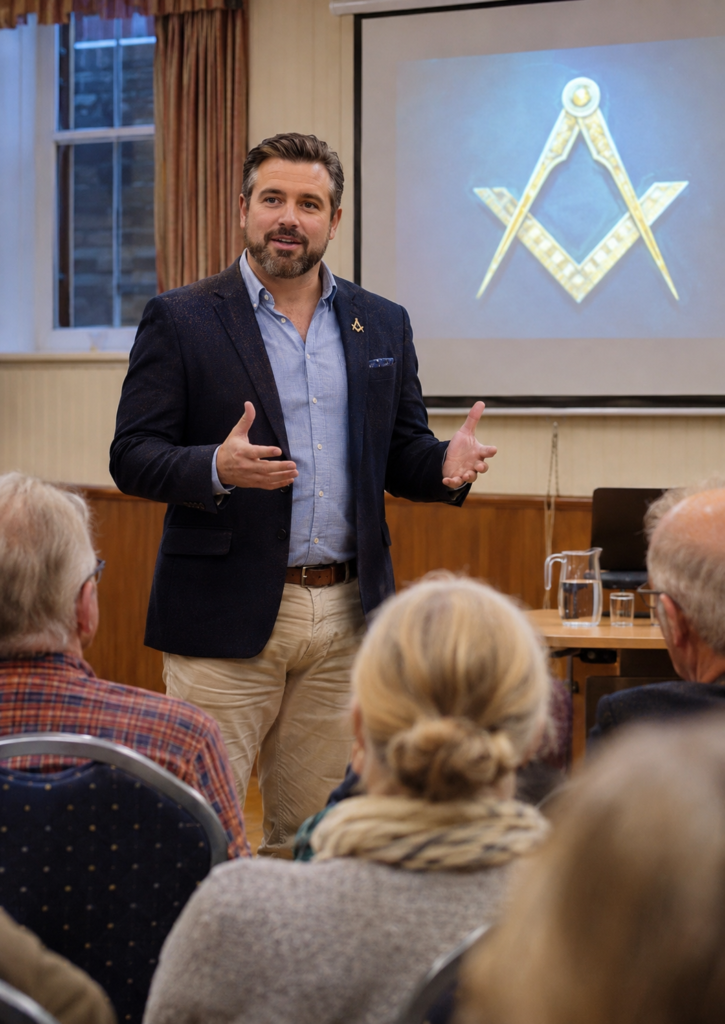
One simple example is the small square and compasses pin I wear on the collar of my coat. Over the years, other Freemasons have noticed it and struck up conversations with me, but it has also caught the attention of people who aren’t Masons. Quite often, somebody will say, “I recognise that symbol, but I can’t remember what it’s from.” Occasionally, they’ll even ask whether it’s something to do with Assassin’s Creed, which always makes me smile. It’s a small thing, but it creates an opportunity to explain what the symbol actually represents and, before you know it, we’re having a conversation about Freemasonry.
If somebody asks where I’m going that evening, I might tell them I’m going to Lodge. If somebody notices something Masonic and asks me about it, I’ll answer them. I don’t suddenly become mysterious and change the subject. And because I write publicly about Freemasonry through Destination Freemason, it isn’t exactly difficult for somebody who knows me to discover that I’m a Mason.
There is an enormous amount that we can openly discuss whilst remaining faithful to our Masonic obligations. I can talk about the friendships, the charity and the history. I can explain what Lodge meetings are generally like, the offices I’ve held, visiting other Lodges, the Festive Board and why ritual matters to me. Most importantly, I can describe what Freemasonry has added to my life.
Sometimes those conversations lead to genuine curiosity. A person who previously knew little about Freemasonry begins to realise that behind all the mythology and strange stories on the internet, there are ordinary men who have found something meaningful in belonging to a Brotherhood.
If We Don’t Explain Freemasonry, Somebody Else Will
This is perhaps where the biggest generational change has occurred. Once upon a time, saying very little probably did protect Freemasonry. Today, silence can have the opposite effect.
If somebody hears the word “Freemason” and becomes curious, what do you think they do? They pick up their phone, and within seconds they can find websites, YouTube videos, TikTok clips, Reddit discussions, documentaries and thousands upon thousands of pages claiming to explain Freemasonry.
Some of them are excellent and some are complete nonsense, but the person searching doesn’t necessarily know which is which. That creates an interesting problem: if Freemasons refuse to talk about Freemasonry, we leave everybody else to explain it for us.
Personally, I would rather somebody ask me. If someone genuinely wants to know why I became a Freemason, I can tell them. If they ask whether Freemasonry is a religion, I can explain that it isn’t. If they ask whether we’re sitting around plotting to control the world, I can unfortunately confirm that nobody has yet invited me to that particular committee meeting.
And if they ask what I actually get from being a Mason, I can tell them that you get out what you put in. It’s a saying I’ve come to appreciate more and more throughout my own Masonic journey. I sometimes wonder whether some of those who join, only to leave disappointed and speak negatively about Freemasonry, ever truly gave themselves the opportunity to experience everything it has to offer. Of course, there will be those whose experiences genuinely fell short of their expectations, but I do believe that becoming actively involved makes an enormous difference.
I’ve embraced that philosophy myself, throwing myself wholeheartedly into Lodge life, taking on responsibilities, learning ritual and making the most of the opportunities that have come my way. And now, looking back, I can see just how much I’ve gained in return, particularly in my own personal growth. I’ve developed confidence, formed friendships and discovered abilities within myself that I might never have explored otherwise.
That doesn’t mean I speak on behalf of Freemasonry. I speak for myself. But sometimes that is all somebody needs. They don’t need a glossy recruitment brochure; they need to meet a Freemason who is genuinely passionate about the Craft, proud to be part of it, and happy to talk openly and honestly about it, whilst remaining faithful to his Masonic obligations.
The Men Who Eventually Walk Through the Door
This has probably been the most rewarding part of my first year as Membership Officer. People have actually walked through the door. Men with whom conversations began outside Freemasonry have eventually become candidates and started their own Masonic journeys.
Once that happens, something changes. The person you originally spoke to about Freemasonry isn’t simply a potential member anymore. He becomes your candidate and eventually, hopefully, he becomes your Brother.
There is a responsibility attached to that which I don’t think we always acknowledge. If I introduce somebody to Freemasonry, I want him to have a good experience of it. I want him to understand what he is joining, feel welcomed when he arrives, and know people before he finds himself standing in unfamiliar surroundings wondering who everybody is. Most importantly, I want the Lodge to be right for him.
We recently had a particularly good example of this at one of our Lodge meetings. While we were welcoming a new candidate into Freemasonry, we also had another prospective candidate join us later in the evening for part of our Festive Board. He wasn’t present for the formal toasts, but he was able to experience the atmosphere of the dining room, see our newly initiated Brother welcomed amongst the Brethren, and enjoy the conversation, laughter and camaraderie that followed.
This is something our current Worshipful Master is particularly keen to encourage, and an approach that I, along with other Brethren in the Lodge, wholeheartedly support. Traditionally, prospective candidates might only meet a small handful of Brethren during their initial interviews before eventually finding themselves standing in a Lodge room surrounded by men they have never met.
I know this from personal experience. Having initially approached Freemasonry through my Province, I didn’t know a single person when I began my journey. After an initial meeting, I was introduced to what would become my Mother Lodge, where I attended a formal interview with around eight Brethren sitting around a table. Everyone was perfectly welcoming, but it was still a rather formal and unfamiliar experience, not unlike attending a job interview.
Looking back, I can certainly appreciate the value of giving prospective candidates the opportunity to meet more of the Lodge beforehand. Sitting down for a meal, sharing a few laughs and seeing how the Brethren interact with one another can tell them far more about the character of a Lodge than any formal introduction ever could. It also works both ways. We get to know them as individuals, rather than simply as names on application forms.
And when the time eventually comes for a prospective candidate to take that first step into Freemasonry, he will already recognise familiar faces, have made a few connections and, hopefully, feel that he is joining a group of men who are genuinely looking forward to welcoming him.
Getting to Know the Man Behind the Enquiry
As Membership Officer, my aim is to bring good men into Freemasonry, but I also recognise the responsibility that comes with recommending somebody for membership. When I put a candidate forward, I am effectively giving my personal endorsement that I believe he would make a suitable addition to our Lodge. That recommendation reflects upon me, and I take that responsibility seriously. It’s why I make a conscious effort to build up a picture of the man behind the enquiry through conversations, emails and, wherever possible, meeting him in person before he takes the next step.
I want to understand why he is interested. What does he think Freemasonry is? What is he hoping to find? Does he genuinely value the idea of Brotherhood and companionship, or does he imagine Freemasonry is going to provide business contacts and personal advantage?
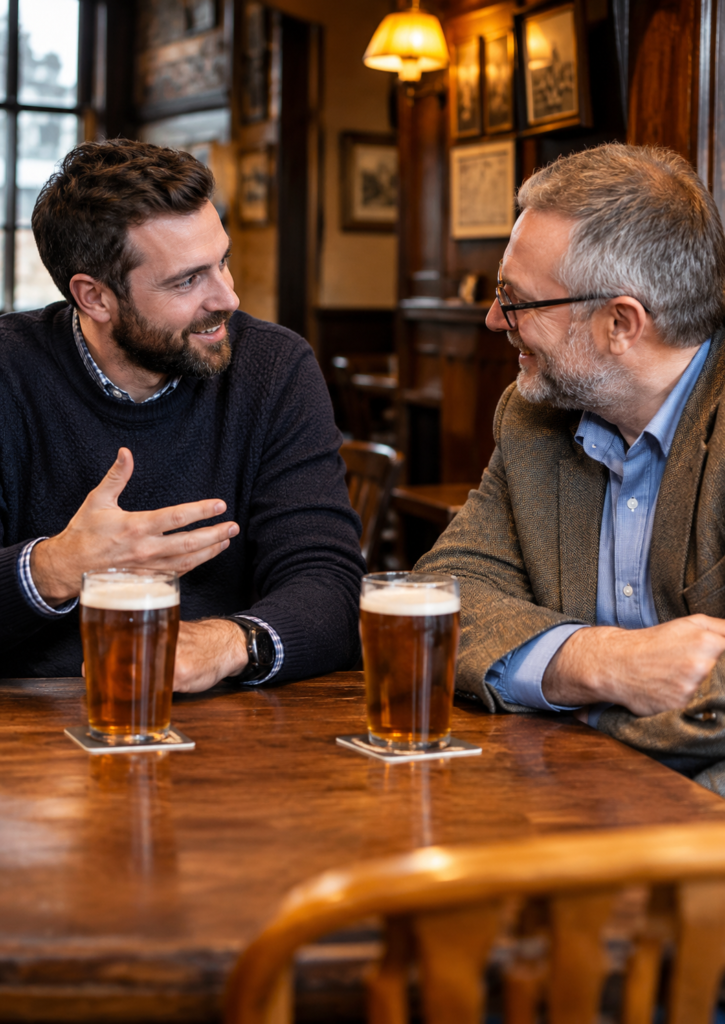
Those conversations allow him to understand us, but they also allow us to understand him. Sometimes that process lasts weeks, sometimes months, and potentially it could last years. That is absolutely fine. Freemasonry has existed for centuries; we don’t need to rush somebody through the door by next Tuesday.
Ultimately, I am not looking for somebody who will appear at Lodge for twelve months and disappear. I am hoping to introduce somebody who may still be sitting at the Festive Board with us twenty or thirty years from now.
The Men Waiting in the Wings
One of the interesting things about being Membership Officer is that much of the work is invisible. A Lodge might initiate one or two men during a year, and from the outside that looks like the entirety of its membership activity. It isn’t.
Behind those candidates may be several other conversations taking place. Someone may have expressed an interest but isn’t ready yet. Another has asked a few questions. Someone else wants to come along to a social event, while another may have been thinking about Freemasonry for years but has never actually known a Freemason to ask.
There are men currently on that journey towards my Lodge. Some may become Freemasons, some may decide it isn’t for them, and some may simply remain friends who once had an interesting conversation with a Mason. All three outcomes are perfectly acceptable.
That is why I think patience is such an important part of the office. Not every enquiry needs to become an application, and not every conversation needs to have an outcome. Sometimes the most useful thing a Membership Officer can do is simply remain available while somebody makes up his own mind.
Recruitment or Attraction?
The more I have thought about this over the past year, the less comfortable I have become with the word “recruitment.” Recruitment sounds transactional: a vacancy exists, we need somebody to fill it, find candidate, complete paperwork, job done.
Freemasonry doesn’t work like that, or at least I don’t believe it should.
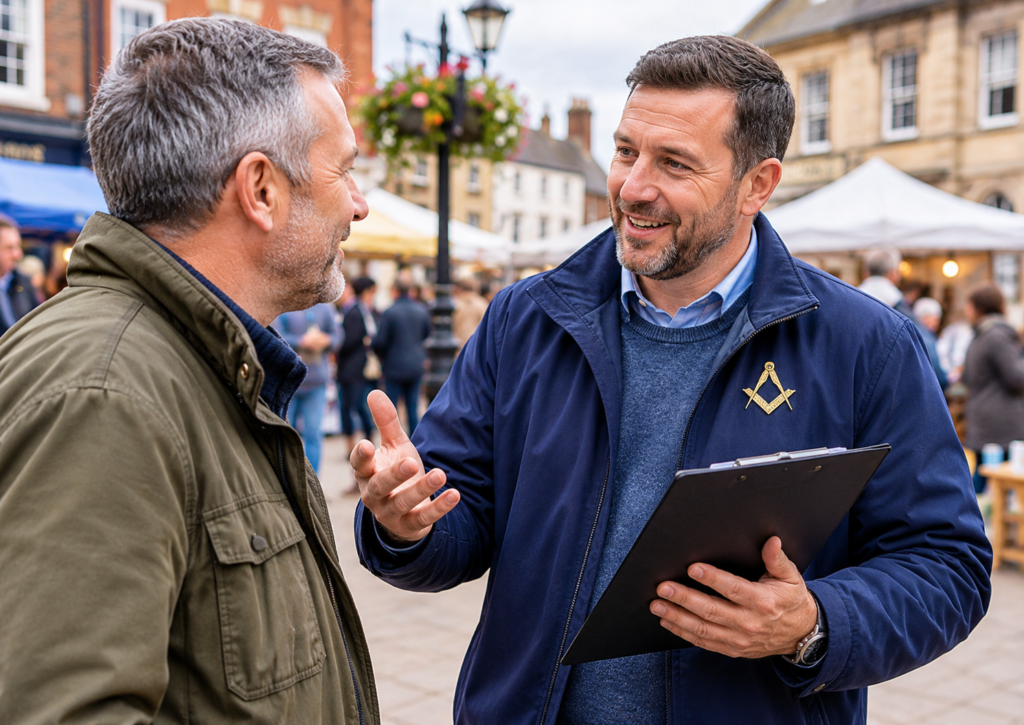
What we’re really talking about is attraction. We should create Lodges that men want to belong to. We should practise Freemasonry in a way that makes existing members excited to attend, treat one another in a way that demonstrates the Brotherhood we talk so much about, and perhaps be a little more willing to let the outside world see that.
There are good men outside Freemasonry who would probably love it. The problem is that many of them have absolutely no idea what we actually do.
Some still believe you have to be invited. Others think you need a family connection. Some assume you have to be wealthy, while others think it is religious or some kind of secret business network. Plenty probably assume Freemasonry disappeared sometime around 1957.
And that raises a bigger question. Perhaps the difficulty isn’t always finding men who would enjoy Freemasonry. Perhaps it is making sure they know enough about it to realise they might want to join.
Maybe Freemasonry Has a Visibility Problem
Whenever people discuss the future of Freemasonry, membership numbers inevitably come up. How do we attract younger members? How do we stop Lodges closing? How do we increase membership and get more people through the door?
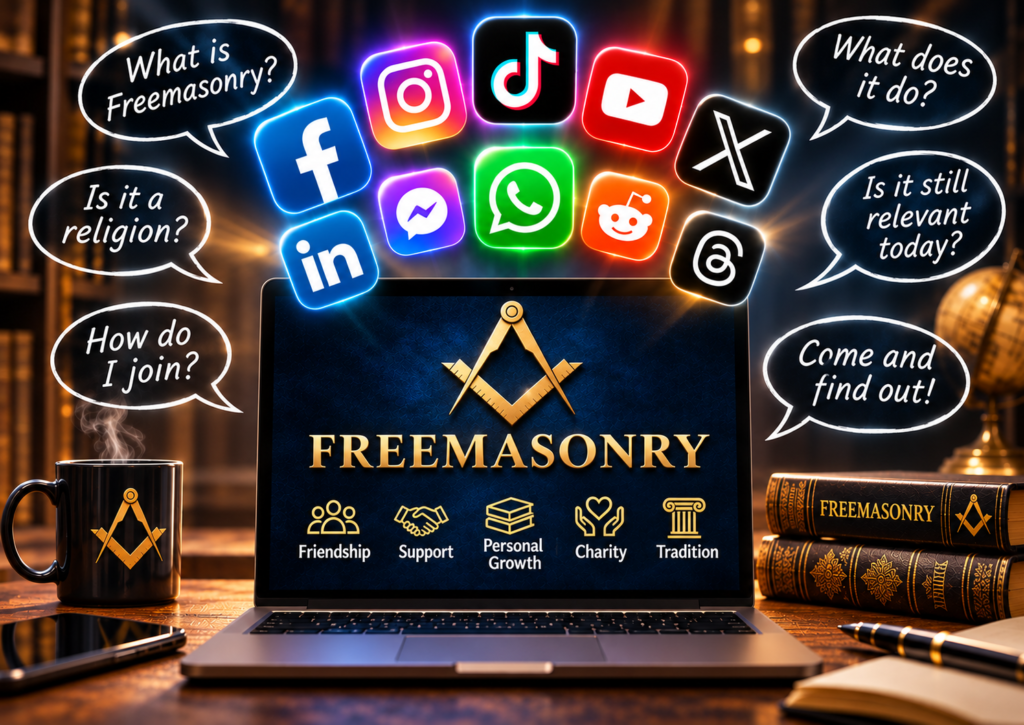
These are important questions, but I wonder whether we occasionally begin with the wrong one. Perhaps the first question should be: how many good men actually know enough about Freemasonry to decide whether they might want to join?
There are men searching for exactly the things Freemasonry offers: friendship, belonging, tradition, purpose, personal development, a chance to contribute to their community, and a fascinating heritage that draws upon stories and symbolism dating back thousands of years.
Yet some of those men could walk past a Masonic centre every day for ten years and have absolutely no idea what happens inside it. That seems extraordinary when you stop and think about it.
During this past year, I have also been reminded that this isn’t merely a theoretical discussion about the future of Freemasonry. It can have very real consequences.
I have heard of a small handful of Lodges that may be considering handing in their Warrants and closing their doors. Whether they ultimately do so remains to be seen, and I sincerely hope they don’t. But even hearing that possibility discussed makes me incredibly sad.
Because when a Lodge closes, we lose far more than a name from the Year Book. Think about everything contained within the history of a Lodge: the men who founded it, the generations of candidates who nervously stood outside its door before beginning their Masonic journeys, the Masters who occupied its Chair, the Past Masters who spent decades supporting it, the ceremonies, friendships, laughter around the Festive Board, charity work, visitors and anniversaries.
Then there are the Brethren who are no longer with us but whose names remain woven into that Lodge’s history. All of that history eventually reaches a final meeting. The Lodge closes, the Warrant is surrendered and the lights are turned off for the last time.
Perhaps that is where my experience during this first year gives me some hope. I certainly haven’t discovered a magical solution to declining Lodge membership, and I would never suggest that a Lodge facing closure simply hasn’t been trying hard enough. There can be many reasons why a Lodge struggles, and some of those problems cannot be solved by one enthusiastic Membership Officer.
But I do think we should recognise just how much difference one enthusiastic Brother can potentially make.
During my own first year, through nothing more complicated than being open about Freemasonry, talking enthusiastically about something I love and being willing to answer people’s questions, I potentially have five men coming into Freemasonry.
Five men in a year.
Not because five is an enormous number in itself, but because of what five new members could mean to a Lodge that is struggling to survive.
Five new Brothers aren’t simply five more subscriptions. They are five potential Stewards, five future Deacons, five future Wardens and potentially five future Masters. They are five men who may themselves eventually introduce friends to Freemasonry, and five men who could still be sitting around that Lodge’s Festive Board twenty or thirty years from now.
All of that can potentially begin with one Brother being passionate enough about Freemasonry to talk about it.
That is why I hope other Membership Officers reading this don’t see my experience as me telling them that they need to “try harder.” That isn’t my message at all. My message is to show your passion.
Remember what made you excited about Freemasonry in the first place. Remember how it felt when you were the candidate. Remember the friendships you’ve made, the ceremonies you’ve experienced, the nights you’ve laughed until your sides hurt and the moments when a Brother has quietly been there when you needed him. Then don’t be afraid to let people see some of that enthusiasm.
Enthusiasm is infectious. If one Mason can potentially bring five good men towards Freemasonry in a year, imagine what could happen if two or three Brethren within a struggling Lodge rediscovered that same confidence in talking about what their Lodge means to them.
Perhaps then, instead of discussing when to surrender the Warrant, the Lodge might eventually have a completely different problem: how on earth are we going to fit all these ceremonies into the calendar?
That is the problem I would much rather see Lodges having.
What the Older Generations Gave Us
There is an important point I don’t want lost in this discussion. Being more open about Freemasonry does not mean rejecting the generations who came before us. Quite the opposite: they preserved it for us.
The Lodges we now enjoy exist because generations of Brethren maintained them. They learned the ritual, occupied the offices, raised money, supported one another, maintained Masonic halls, initiated the next generation and eventually welcomed men like me. We owe them an enormous debt.
So this isn’t about saying the old way was wrong. It is about recognising that the world in which Freemasonry now operates is different from the world in which many of those traditions developed.
Perhaps our responsibility is to preserve the principles while adapting the way we communicate them. Keep the landmarks, the ritual, the traditions and the dignity. Keep the things that make Freemasonry Freemasonry, but make sure the next generation knows that we’re still here.
What My First Year Has Taught Me
When I originally took on the office of Membership Officer, I probably thought more about candidates. A year later, I think much more about the relationships that develop before anybody joins, and the responsibility a Lodge has to those men once they do.
I’ve learned that a prospective candidate doesn’t necessarily need to be persuaded. He needs the opportunity to understand what Freemasonry is, to meet the men who practise it and to decide whether it is something he genuinely wants to become part of.
I’ve also learned that the work doesn’t end with an Initiation. Bringing somebody into a Lodge is only the beginning. If he is going to stay, take part, form friendships and eventually contribute to the future of that Lodge, he needs to feel that he belongs.
And if I had to reduce everything I have learned during this first year to one lesson, it would probably be this: don’t be frightened to talk about something you are proud of.
Looking Towards Year Two
So where does that leave me after my first year? Excited, actually.
There are new members beginning their Masonic journeys, with other prospective candidates potentially following behind them. I don’t know how many will eventually take that first step into Freemasonry, but I look forward to finding out.
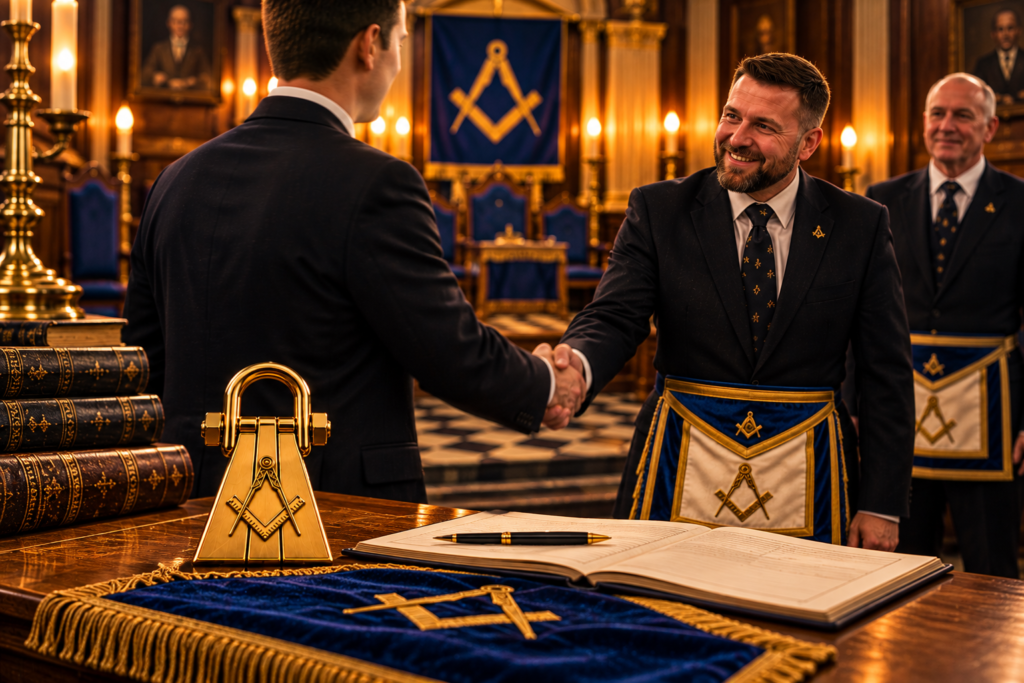
What matters to me is that those who do join find something genuinely worthwhile. I hope they discover the friendships, enjoyment and sense of belonging that I have been fortunate enough to experience, and that, in time, they develop their own reasons for being proud to call themselves Freemasons.
Because attraction alone isn’t enough. Attraction gets a man through the door. Brotherhood keeps him there. And if we are serious about securing the future of our Lodges, we all have a part to play.
After all, every Brother has the potential to be a Membership Officer, whether he holds the title or not. We all have opportunities to share our experiences, talk openly about Freemasonry and explain what being a Mason means to us personally. It doesn’t require a formal office or a recruitment strategy. Sometimes, all it takes is a simple conversation with someone who has never had the opportunity to speak to a Freemason before.
Sometimes, all we need to do is show the next man where the door is.
.